✦ Work
GroupHead
AI-assisted espresso machine troubleshooting for baristas
Role
Product Designer - UX, interaction design, information architecture, mobile UI
Team
Lead Designer, Domain Expert
Year
2026
TimeLine
In-progress
Problem Statement
Cafés rely on espresso machines as critical equipment, but when issues arise, baristas often lack the diagnostic knowledge to determine whether a problem is simple, unsafe, or requires a service technician. As a result, machines are frequently taken out of service unnecessarily, leading to lost revenue, costly repairs, and increased stress for staff and owners.
Existing support options such as manuals, static troubleshooting guides, or calling a technician, are either too technical, too slow, or disconnected from the realities of a busy café environment. Baristas need a way to quickly and safely understand what’s wrong, what actions are appropriate, and when escalation is truly required.
Goal
Design a mobile-first troubleshooting experience that helps baristas diagnose and resolve common espresso machine issues safely and confidently, while clearly signaling when professional service is necessary.
The product aims to:
Reduce unnecessary service calls and downtime
Improve barista confidence during equipment failures
Prioritize safety in high-risk scenarios
Provide clear, trustworthy outcomes rather than open-ended guidance
This project is ongoing and serves as an exploration of mobile, AI-assisted interaction design within a high-stakes operational environment.
My Role
I'm leading the end-to-end design of this project as a Product Designer, including problem framing, information architecture, interaction design, and mobile UI.
Defined the core user problem and experience goals
Designed the information architecture and end-to-end journey
Prototyped mobile flows and resolution states
Collaborated with a domain expert in café operations and espresso machine repair to ground the experience in real-world workflows and safety considerations. We used this knowledge to create the AI interaction model, including safety gates and escalation logic.
Key Features
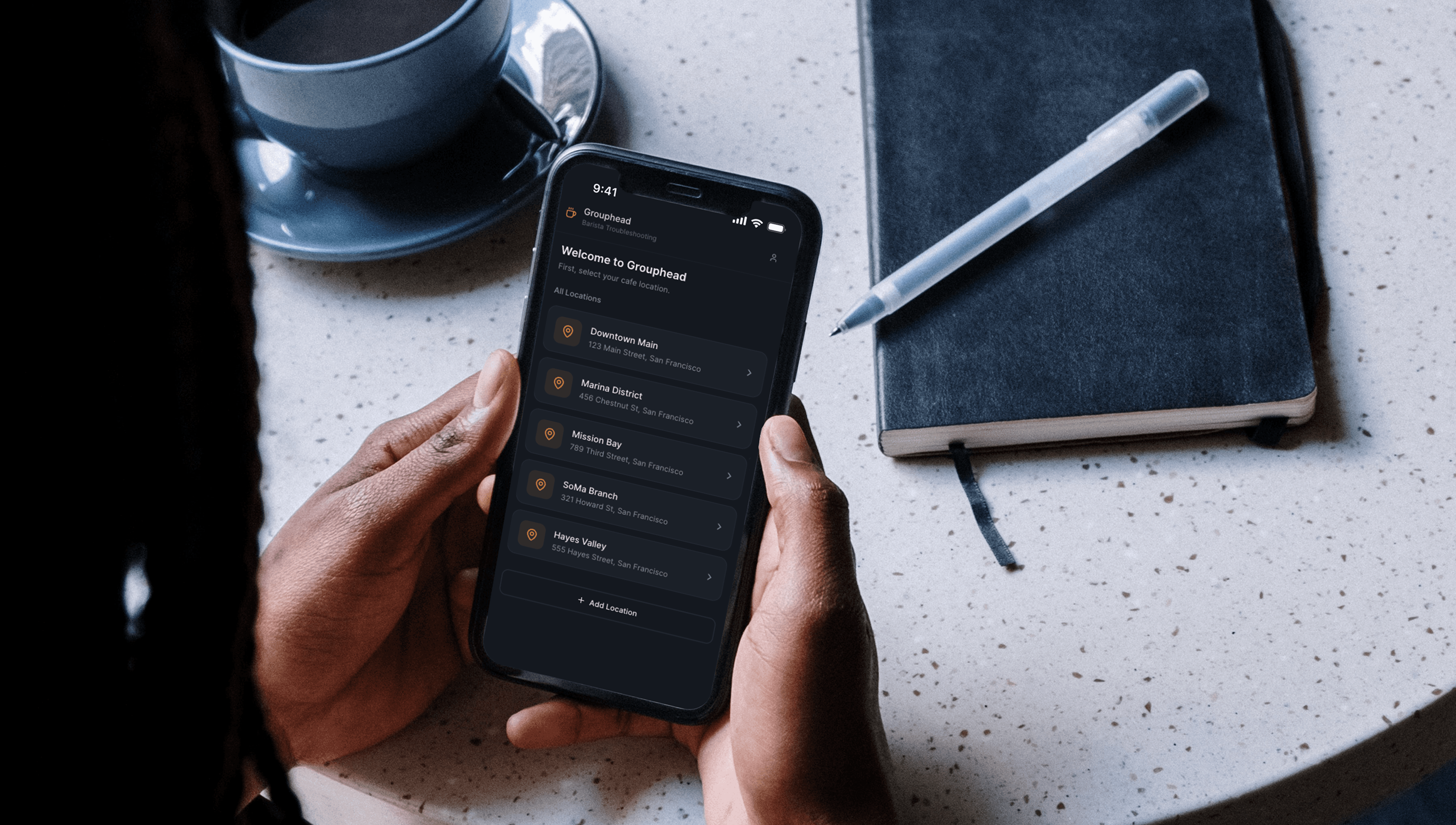
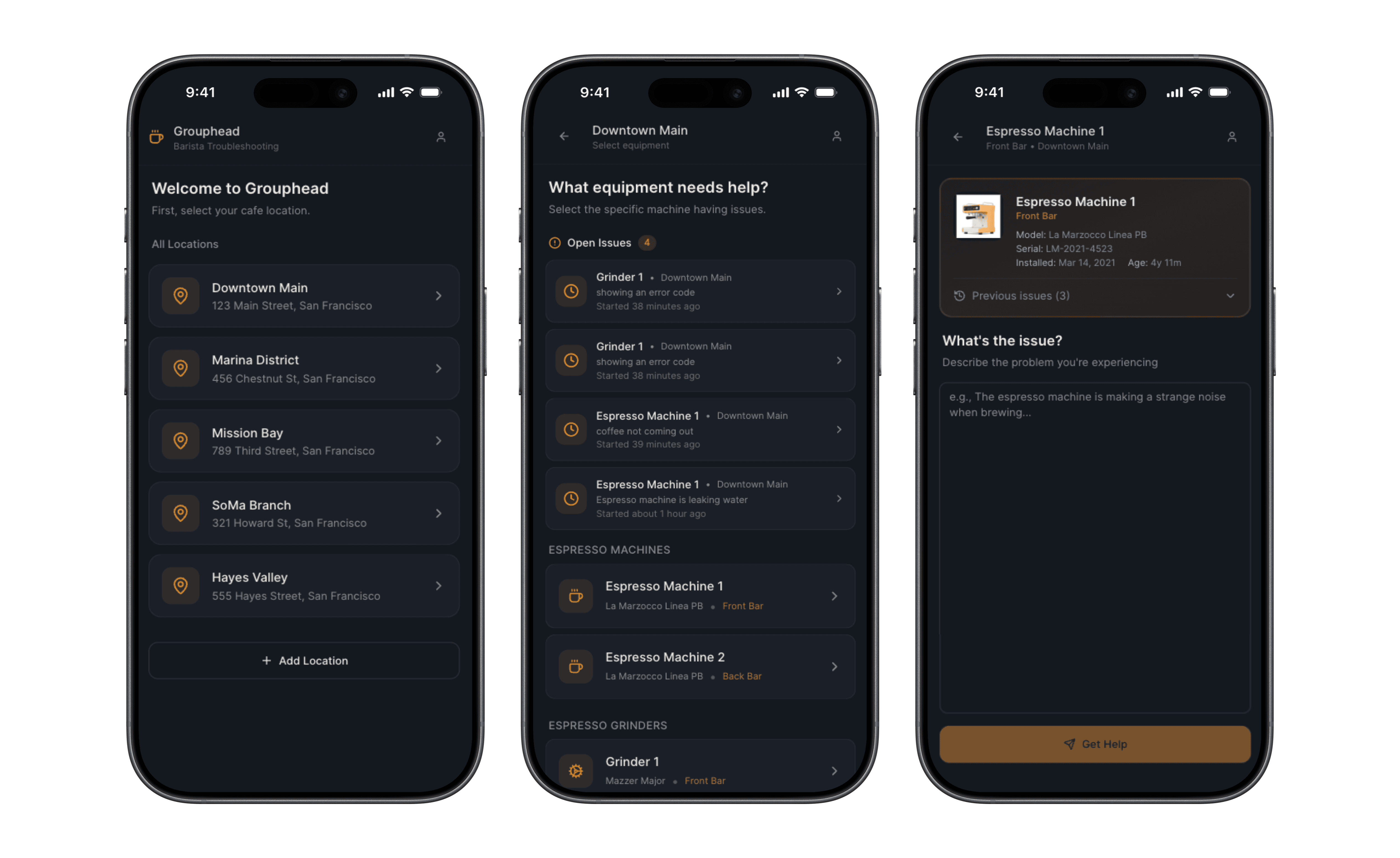
Contextual Equipment Overview
Baristas select a specific café location and machine, grounding troubleshooting in real equipment data such as model, age, and service history.
AI-Guided Troubleshooting
A general-purpose LLM provides conversational reasoning, while domain-guided prompting shapes how the system diagnoses issues, asks clarifying questions, and determines next steps. Safety gates and escalation logic prevent unsafe guidance and clearly signal when professional service is required. The result is a conversational interface that behaves like a senior technician, asking one high-signal question at a time, adapting to uncertainty, and avoiding technical jargon.
Safety Gating & Confidence Thresholds
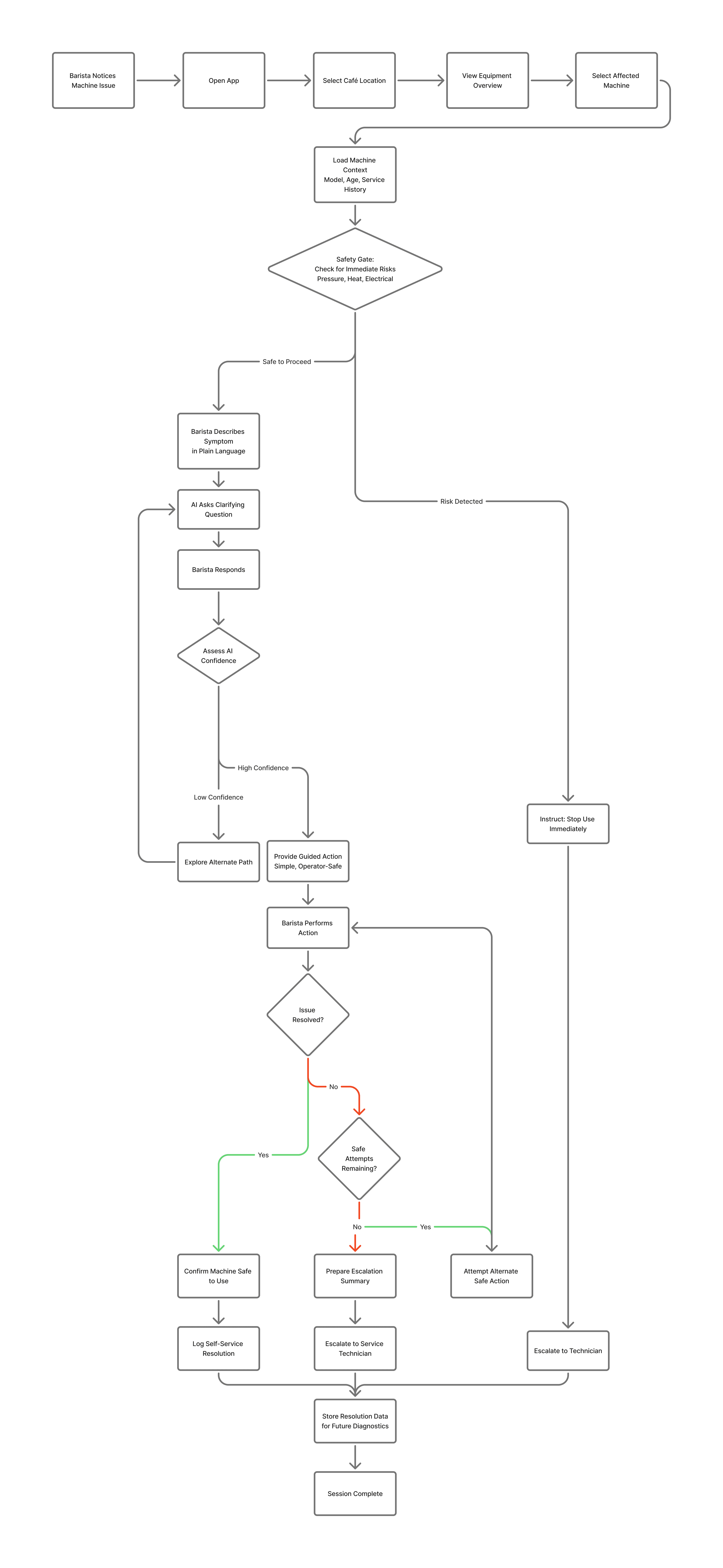
Immediate safety checks prevent unsafe actions. The system only guides barista-resolvable steps when confidence is sufficiently high, and escalates otherwise.
Guided, Operator-Safe Actions
Clear, concise instructions designed for non-technical users, focusing on actions that are safe to perform during service.
Clear Resolution States
Every session ends in a definitive outcome: either a confirmed self-service resolution or a clear escalation path with summarized findings for a technician.
Resolution History
Issues and outcomes are logged per machine, supporting future diagnostics and long-term trust.
Goals
Understand how café staff currently respond to espresso machine issues, where uncertainty and anxiety arise during troubleshooting, and what information is most critical for making safe, confident decisions under time pressure.
This research focused on identifying:
Moments of high stress or confusion
Information gaps during machine failures
Safety risks and escalation triggers
Opportunities where guided support could prevent unnecessary service calls
Method
Because this project is in an exploratory phase, I used qualitative, formative research methods to inform early design decisions.
Methods included:
Domain expert collaboration to map real-world troubleshooting workflows and safety considerations
Scenario-based simulations of common espresso machine issues to test interaction flows
Task walkthroughs to identify decision points, dead ends, and failure recovery moments
Comparative analysis of existing support options (manuals, service calls, static guides)
This approach allowed me to pressure-test the interaction model before conducting live usability testing.
Governance Documentation
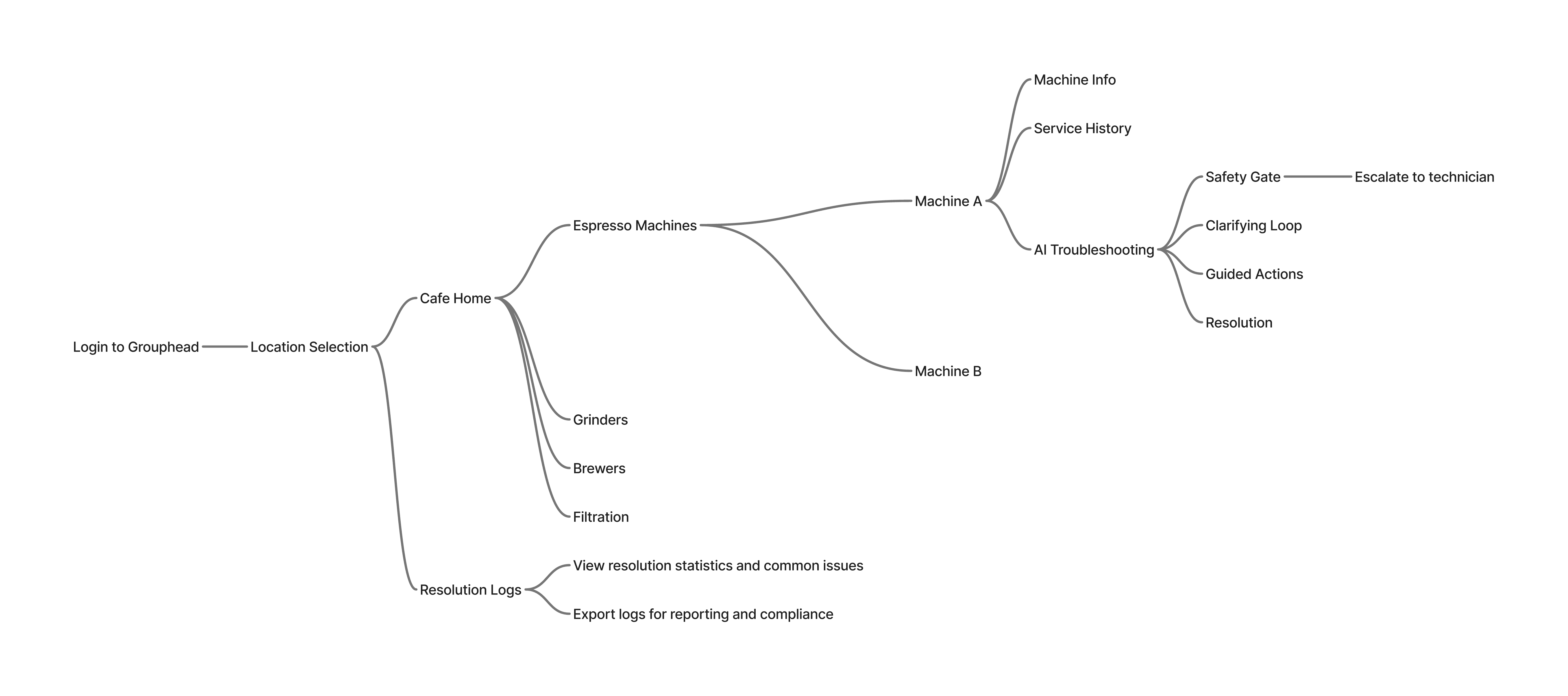
System Information Architecture (IA)
Key Findings
Uncertainty is more stressful than the problem itself
Baristas are often willing to help fix issues but lack confidence in their diagnosis.Safety clarity is critical early
Users need to know immediately whether they should stop using the machine or continue troubleshooting.Linear troubleshooting breaks down quickly
Symptoms are often misdescribed, requiring adaptive questioning rather than static decision trees.Clear end states build trust
Baristas want definitive outcomes, either “this is resolved and safe” or “this requires service.”Context matters
Machine history and prior issues help users feel more confident and reduce repeated questioning.
User Flow

Next Steps
Integrate the AI’s domain-guided reasoning layer into the Lovable prototype to evaluate the conversational troubleshooting experience in a real mobile context.
Refine resolution states and session completion behavior to ensure every flow ends with a clear, trusted outcome.
Conduct lightweight real-world validation to test assumptions behind the interaction model, safety gates, and escalation logic.
Validation Questions
Effectiveness
Can a general-purpose language model configured with domain-guided prompting reliably guide a barista with no technical background through low-effort fixes without requiring external support?
How often does the system reach a confident resolution without escalation?
Usability under pressure
Can baristas correctly interpret and follow AI-guided instructions during a busy shift?
Where do users get stuck or provide ambiguous input?
At what point do users abandon the flow due to time pressure?
Safety & trust
Do users clearly understand when it is safe to continue troubleshooting versus when to stop and escalate?
Do baristas trust the system’s safety warnings enough to stop using a machine when prompted?
Are confidence thresholds and escalation moments perceived as reasonable and credible?
Operational fit
How does troubleshooting fit into real café workflows during service?
What contextual information (machine history, prior fixes) is most valuable in practice?
Future Validation & Expansion
Test photo or video input to improve symptom recognition and reduce ambiguity
Validate resolution logging and technician handoff with service providers
Measure impact on machine downtime and service call frequency over time